

So there’s another apocalyptic asteroid warning in the tabloid news headlines.
The lead scaremongerer appears to be the Daily Express, who started out playfully alerting us to asteroids that will skim by Earth in the coming days. But it didn’t take long for a war of the digital world to start warning of swarms of asteroids, with hair-raising news headlines.
Take a look at those below—or just look on Google.
“Asteroid alert: NASA tracked rock about to skim Earth at 23,400 mph – Will it hit?” Express, 2 October 2019. Read
“Asteroid terror: Fears of human extinction as three monster rocks head towards Earth.” Express, 5 October 2019. Read
“A swarm of asteroids is headed in the direction of Earth, Nasa reveal.” Metro, 8 October 2019. Read
“Asteroid warning: NASA panic as four killer space rocks avoid horror impact with Earth.” Express, 2 October 2019. Read
“Asteroid larger than the Shard set to skim past Earth next month, NASA warns.” Independent, 26 August 2019. Read
“Asteroid warning: Apocalyptic ‘God of Chaos’ powering towards Earth in time for 2029.” Express, 25 August 2019. Read
“Asteroid warning: Universe is trying to ‘KILL US OFF’ – warning.” Express, 28 August 2019. Read
Do we have impact?
After we’ve all calmed down from the panic of an impending apocalypse (and stocked up on loo roll, dried lentils and bottled water), what is the threat to Earth from these asteroids the size of buses, towers and stadia?
Let’s look at information in NASA’s databases about some one of the asteroids in the headlines. Take, for example, the first headline above from The Daily Express on 2 October 2019 the asteroid about to “skim Earth at 23,400 mph”. We know the asteroid didn’t hit, but what was the risk?
The headline refers to asteroid 2018 FK5. This little asteroid was discovered on 28 March 2018 during a close approach with the Moon, but it has had three close approaches to Earth since its discovery date and, maybe, many more prior to that because it’s been around since the formation of the Solar System.
The actual number of close approaches depends on when the asteroid was nudged or ejected away from its original orbit in the asteroid belt and into a near-Earth orbit. Bear in mind that this rock was once part a larger body that resided in the asteroid belt for some four and a half billion years.
The headlining close approach took place on 1 October 2019 at 22:56 (UT), as shown in the NASA-JPL orbit diagram below. In metric units, the asteroid was travelling at a speed of close to 38,000 km per hour or about 10.5 km per second. NASA calculations show 2018 FK5 would pass by Earth at a distance of 0.034 astronomical units (AU). Since 1 AU is equal to 149.6 million km, that’s a distance of just over 5 million km, roughly 13 times further away than the Moon (which orbits Earth at a distance of around 380,000 km). Below is the NASA-JPL orbit diagram showing the position of the asteroid with respect to Earth at the close approach on 1 October 2019.


In 2018, on 30 March, the asteroid passed by even closer to Earth at a distance of a little over 0.001 AU, which is less than half the Earth-Moon distance. The next closest approach to Earth will be on 1 April 2026 at 21:06 (UT), when it will pass within a distance of 0.053 AU to Earth, or 21 times the Earth-Moon distance. You can search the list of distances and dates here.
Asteroid 2018 FK5 is estimated to have a diameter somewhere between 5.8 and 13 metres. For scale, a London bus is about 8.5 metres in length. According to NASA, any rock up to about 25 metres in diameter is unlikely to survive its passage through Earth’s atmosphere. These just break up and rain down harmlessly as small meteorites and micro-meteoroid dust.
So asteroid 2018 FK5 was not likely to be a threat.
Having said that, the Chelyabinsk meteor event over Russia on 15 February, 2013 was caused by a small 20 metre-sized asteroid. The Chelyabinsk meteoroid had gone undiscovered prior to the event because its radiant (that is, its originating path on the sky as viewed from Earth) was close to the Sun making the asteroid difficult to spot. Coincidentally, on that same morning, all eyes were trained on the close approach of a different asteroid, the 30 metre-sized asteroid 2012 DA14 (367943 Duende), which passed safely by Earth 28,000 km further away than the Chelyabinsk meteoroid. You can read more about those two asteroid events in one of my earlier posts here.
One for the preppers
NASA’s Center for Near-Earth Object Studies (CNEOS) maintains impact risk data in the form of the Sentry Risk Table, a database which is updated using an automated monitoring system that scans the asteroid catalog for possibilities of future impact with Earth over the next 100 years.
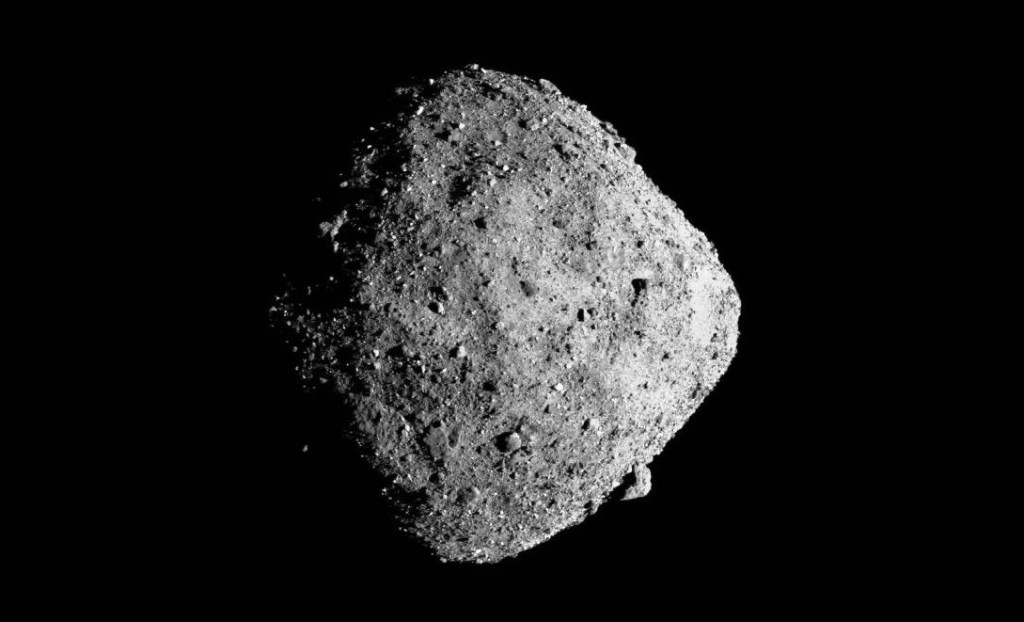
Although our little asteroid 2018 FK5 does not feature on the potentially hazardous objects list, a larger rock, the 500 metre diameter asteroid 101955 Bennu, does feature on the list. There is currently a risk of 78 potential Earth impacts by asteroid Bennu over the next 100 years.
But don’t panic!
According to the NASA Sentry risk data, the cumulative probability of an impact by Bennu (meaning the sum of probabilities from all calculated potential impacts) is 3.7e-4, that’s a 0.037% or 1 in 2,700 chance of impact between the years 2175 and 2199. Putting it another way, there’s a 99.963% chance that it will miss us.
Currently, the highest risk of impact by Bennu is on 24 September 2196, with a 1 in 11,000 chance of impact during that closest predicted encounter. However, earlier close encounters with Earth, such as one in 2135, could alter the asteroid’s trajectory and subsequently increase or decrease the risk of future impacts, so the probability of impact quoted above is the current estimate only.
Asteroid Bennu (full name 101955 Bennu, original provisional designation 1999 RQ36) is one of two asteroids being visited by sample return spacecrafts at the time of writing. The other is a one kilometre diameter asteroid named 162173 Ryugu (the original provisional designation of which is 1999 JU3) but this asteroid is not a threat and therefore not on NASA’s Sentry impact risk list. Calculations indicate that the closest distance that asteroid Ryugu will come to Earth is 0.0104 AU on 6 December 2076, which is just over four times the Earth-Moon distance.
Who’s zoomin’ who?
Although asteroid Ryugu poses no impact risk to Earth, the reverse cannot be said of the activities of JAXA’s Hayabusa2 spacecraft which at the time of writing was orbiting the asteroid and had been since June 2018. A high velocity impactor (basically a big metal bullet) is one of a series of objects which bombarded the surface of the asteroid since the spacecraft arrived, as scientists attempt to understand the composition and properties of this near-Earth asteroid—and grab some samples to go.

I don’t make a habit of anthropomorphising asteroids, but it hasn’t gone unnoticed that tweets from Ryugu’s Twitter account @162173Ryugu dried up in April 2019 after a metal bullet—a small carry-on impactor referred to as the SCI—was fired into the asteroid surface. I suspect the account holder (an amateur planetary scientist) saw it as the perfect opportunity to get out of tweeting about the asteroid by dramatising its demise. The last thing we saw before the Twitter account was terminated was a banner advertising an episode of SCI:RYUGU.
Back to reality and Hayabusa2’s departure date from asteroid Ryugu’s orbit is in December 2019, returning to Earth in December 2020 with its bounty of precious rock samples plundered from the surface during the various impacts. After a year of bombardments, if Ryugu really were able to express itself, I suspect it would be thinking that Hayabusa2’s departure cannot come a moment too soon.
In the interests of impartiality, I should mention that asteroid Bennu also posts on Twitter as @101955Bennu from its near-Earth orbit, although we all know the tweets are coming from closer to the University of Arizona in Tucson.
Fact or fiction, real to reel
I hope you enjoyed this post and continue to be entertained by apocalyptic asteroid news headlines. Despite the drama, if you take the time to read those articles, there might be a small sliver of a fact buried beneath the pile of terror-filled text.
If you do have an appetite for Earth-threatening asteroids, read my earlier post Making an Impact: Lights, Camera and Asteroid! which runs through all the movies, TV shows, mockumentaries and informative dramatised documentaries that feature asteroids, comets or other space rocks threatening our planet. It’s a long read and you will need to commit—or just skim the short version.
How are asteroids actually named?
When an asteroid is first discovered it is given a provisional designation (such as those already mentioned above: 2018 FK5, 1999 RQ36, 1999 JU3). The first four numeric digits indicate the year of discovery. The remaining alphanumeric digits denote when during that year it was discovered. The alphanumeric code is set by The Minor Planet Center, part of the International Astronomical Union (IAU). You can read more about the provisional naming convention on the Minor Planet Center website here.
When an asteroid’s orbit is precisely known, it is given an official name – for example, 1999 RQ36 is now 101955 Bennu, and 1999 JU3 is now 162173 Ryugu. Asteroid 2018 FK5 doesn’t yet have an official name. You can read more about official naming conventions here.
Often the discoverer submits a name for approval to the IAU’s Committee for Small-Body Nomenclature. This could be their own name or otherwise; some choose a pet, a famous scientist, or a fictional character, for example. But in some cases the names are chosen from international public competitions. This was the case for the two asteroids provisionally named 1999 RQ36 and 1999 JU3. They now have the official names 101955 Bennu and 162173 Ryugu, respectively. The prefixed numbers for those two asteroids just indicate that they were the 101955th and 162173rd asteroids, respectively, to receive official names.
You must be logged in to post a comment.